Search:     Go  
The Spanish Lawyer Online

Antonio Flores’ Blog

Thoughts about laws and regulations which affect foreigners in Spain

Archive

Archive for the ‘Mortgages’ Category

Be Wise: Stay Well Away From Wise Mortgages

November 9th, 2010

The worst scourge of the Costa del Sol never sleeps. If we were used to boiler rooms selling shares, timeshare, legal services (sadly still operating and preying on those who have already lost money to some other boiler room), the very latest scam has now adopted the form of a 120% mortgage loan.

Wise Mortgages, run by a chap who answers to the name John Gladstone, is offering steroidal 120% LTV (loan-to-value) mortgages. The funny thing (there is certainly no fun if you have been stung) is that he claims that a company he works with lends the money.

The mechanism of this loan scam is based on the advance fee fraud, where you pay for something you never get. In the case of Wise Mortgages you end up paying for, probably (as I don’t know anyone who has paid for more than 1 concept), three different concepts: valuation, arrangement fee and insurance policy. I don’t think there is any more to say about this despicable man and what he does, but before I close the post, below is an open letter to Mr John Doust, the real name of John Gladstone.

Open Letter to John Gladstone

Hello John,

No doubt that when reading this post you’ll be taken over with raging fury, surely, as I would if I was framed looking like a silly crook signing worthless paperwork. But think about it for a second, you should be grateful to me: I am saving you from being arrested, yet again, by the Malaga Police Fraud Department II (that is, if you run fast).

We have had a coffee together and I have asked you a straight question: who is the guy on the picture, do you know him? And you have chosen to tell me, several times, that he is the originator of the concept of Wise Mortgages and that you hardly ever see him. You have then also warned me that I should keep it under my hat because it could bring me problems, as a few people who exposed Doust have been jailed for attempting to defame “him”.

You may recall that we spoke on the phone (and I recorded you), and asked you again the same straight question: do you ever see John Doust? And again, your answer was: hardly ever, he lives further down the Coast, but is not relevant anyway. Oh yes, hardly relevant, especially when you can hardly avoid seeing your own self every second of your life.

Also, there are some recordings where you deny seeing John Doust, where you say that these mortgages are whiter than white and a few other lies. You don’t lie however when you admit that google is a terrible thing, for you, that is (not for your existing and future victims).

John, because you are hardly a descendant of Gladstone , you are in fact John Doust, previously John De L’Ouest and at times Michel West or John Michael, a tall and chubby man boasting an unrivalled criminal history and probably the oldest-serving conman currently still roaming the Spanish Costas, operating from an anonymous 3rd floor rented office in a central Marbella building.

So no hard feelings John: I don’t think that you are an unpleasant man but your time as a fraudster is now over: the inexorable march of technology has made it now very difficult to hide your criminal activities behind a silly website offering impossible 120% mortgages (you even have the arrogance to actually contemplate lending this money if HSBC doesn´t!) and the cheerful and “wise” yet fictitious disguise figure of John Gladstone, which you have thought up as being a descendant of the pensive 19th Century 4 times Primer Minister of England (below).

Mortgages, Scams , , ,

How Can Lawyers Help Struggling Borrowers With Their Mortgage Loan

November 5th, 2010

Following my previous post, where I propose a decalogue of tips to obtain a response from the bank when it is just not possible to keep repaying, below I have excerpted a sample of a letter of instruction, given to a lawyer, to act on behalf of the troubled borrower when nothing else has worked. The associated fees are not so important (there is absolute freedom in this respect) but it would give a guidance as to what should be expected when having to deal with this scenario and the actions that can be taken.

Letter to Potential Client

Dear Mr Doe

In relation to our services regarding your mortgage loan, our firm can act for you in three distinct stages:

  1. Actions to attempt to reduce the mortgage installment whether by re-mortgaging, conversion of the repayment to interest only, reduction of the interest rate being applied (3.5 % should be the interest payable now) or a combination of all. The acceptance by the bank implies signing a contract with the new conditions and requires that you are present, unless we act for you with a power of attorney.
  2. Actions to attempt to obtain an agreement whereby the debt is to be cancelled against transfer of the property to the bank, if repaying a loan is not possible. The acceptance by the bank implies signing a mortgage deed of transfer of the property and requires that you are present, unless we act for you with a power of attorney.
  3. Actions in a Court of Law should none of the above are attained. In this instance you may need to have a lawyer acting for you if the equity on the property is substantial as you may wish to try to sell before auction (or ensure you get a fair deal) and this requires liaison with Court proceedings. Also, if you reach the auction stage, having a lawyer may help in ensuring that if there are bidders for the property they can get the information for the property promptly, even if it means providing them with access to it (many bidders refrain precisely because they cannot access the property, which is an obvious thing!). Finally, note that it is possible for the bank to foreclose and adjudicate the property, through the Courts, for 50% of the value of the property for mortgage purposes (that generally coincides with the valuation), which could be far less than the debt. This means that if the value of the property is 100.000 the debt is 90.000 Euros, the bank could end up keeping the property for 50.000 Euros, and you would still owe 40.000 Euros. It is therefore recommendable to appoint a lawyer and find a “dummy” bidder (who would be a friend) to force the bank to push up the bid as much as possible. This however would require lodging 30% of the value of the property for mortgage purposes, a deposit that would be reimbursed by the Courts.

Courts can take up to 12 months to finally adjudicate the property to the creditor or a third party so there is some time to act.

If the equity is negligible or negative (the outstanding mortgage loan will need to be increased by an average of 10 per cent for legal fees and arrears) there is no point in incurring in heavy legal fees unless there is an opportunity to sell it, or there is a risk that a substantial portion of the debt will remain unsettled (as explained in point 3).  Renting the property during this period will bring in some cash but it is advisable to inform the tenant of the situation, unless it is for short rental.

Our fees to act on your behalf have already taken into account the financial difficulties faced and are as follows:

  • For Stage 1: 750 Euros plus VAT (inclusive of signing at the Notary office).
  • For Stage 2: 1400 Euros plus VAT (inclusive of signing at the Notary office
  • For Stage 1 and 2: 1600 Euros VAT.
  • For stage 3: will depend on the value of the property (minus whichever amount paid as above).

Although it is not possible to force banks to agree, acting quickly can help your position as bankers sympathise with borrowers who are sincere and upfront in their proposals. We are aware that your current predicament is shared by many property owners and that you may sustain a monetary loss if you eventually lose the property. In addition, it is important that you take some measures to limit or even eliminate completely any bad credit records both in Spain and in your country as well as to try and prevent any further action by the bank.

Mortgages, Property, Uncategorized , ,

10 Tips to Increase Your Chances of Success in Handing Back the Keys to Your Bank

November 4th, 2010

After absorbing tens of thousands of properties through negotiation with defaulting borrowers, or via foreclosure proceedings, banks are now property-sicker than ever to take on anymore bricks and mortar that are less valuable than the loans registered against them.

When not being able to repay the loan and when such loan is well over the value of the property, one has to implement some creativity when attempting to convince the lender that they should book an appointment at the Notary Public to arrange the process of Dacion en Pago, where your loan is cancelled against transfer of title to the bank (or in plain English, handing over the keys to the bank), without going to Court.

Unfortunately, this is generally quite difficult to achieve, but where there is no other option, one has to press on. Here are a few tips, some of which I have borrowed from Manuel Gonzalez, a blogger expert in the matter :

  1. Find ways to get rid of other assets you may have: Careful however, do it before you start defaulting as you could be accused of concealment of assets (alzamiento de bienes).
  2. Stop paying: Some people like to think that by keeping up the repayments you are a more authoritative negotiator. Quite the contrary! If they see that you are repaying there is no need for them to waste their time with you.
  3. Understand your enemy and know the way he thinks: Understand what is the reason for them not to be interested in keeping your property, and why that keenness in “screwing you”. So when approaching a bank manager or clerk, try to concentrate on attacking the lender as an entity, not the person individually, even if he was the guy who shook your hand when you first bought the property. These guys, understandably, will be following instructions, and so it will be better to befriend them, as they may be in your position tomorrow and could even share some tips with you.
  4. Prepare your paperwork and check the value of the property for mortgage purposes, if it is equal or higher than the debt you have.
  5. Approach the bank manager, and if possible, the area risk manager, and expose your predicament. Try to have empathy and expect and demand same, they could be sacked by close of business (day).
  6. Have a formal notice sent to the bank: It is important the your meeting and your intentions are documented. A burofax is the preferred and cheaper method.
  7. Persevere: You are already causing discomfort to the persons working in the branch and to the entity, which is very good. If you have the time try to pay them a visit every day or every other day, although always in a friendly manner. You will manage to stand out from the rest of dacion en pago pursuers and will come across as a man/woman on a mission.
  8. If credible, advise them that you are leaving the country as you have managed to secure a 10 year contract as a dockmaster in Antananarivo port, Mauritania, or an equivalent extravagant location. Have your supporting paperwork ready, and if you don’t have it just make it up!
  9. Don’t fall for the branch manager scaremongering tactics: Make sure that you show no emotions when they tell you that, if you stop paying, they will take you to court, and that your debt will exponentially grow with all those lawyers’ fees, arrears interest and costs, as bank managers are used to saying. Offer them a friendly grin and the shoulder shrug, which incidentally will also help you train your trapezius muscles. Also, don’t be so silly to wear your best suit and Italian shoes when meeting with the area risk manager. Smart but casual is the norm: sporting sandals, or flips flops, with socks, will do the job. I suggest something like this.
  10. And finally, be ruthless, just like they are and have been with you since you first stepped into that branch.

Mortgages, Property , , ,

The Danske Bank Equity Release Fiasco

October 15th, 2010

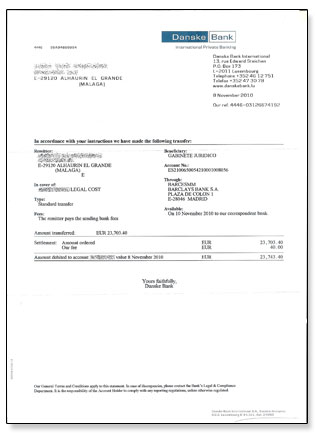
Surfing the web in search for information on the so-called equity-release fiascos, I came accross a very interesting article in respect of Danske Bank being sued by around 100 customers over the loss of 80% of their investments on an financial product that, allegedly, the bank sold as being low-risk.

According to the bank, the investment project was sold only to wealth customers, who were provided with adequate information about the risks. According to the financial experts at Oslo University, the project was presented to the customers as being far less risky than it actually was, and according to the lawyers dealing with the case, their clients would have never invested in the product if they had been fully informed of the risks.

I happen to have one client in the same situation, although with a distinct difference. He was not sold the product directly by the bank, but by an insurance broker based in Alicante, registered with the DGS (Insurance Directorate General) to sell life insurance policies.

The Facts of the Case

Who’s Who

  • Danske Bank: a Northern European financial services provider, authorised by the Danish Financial Supervisory Authority. It is currently the largest bank in Denmark and is listed on the stock exchange.
  • OFS Spain (Overseas Financial Services): An insurance services intermediary company based in Calpe. This company is not authorised by the regulator (CNMV) to operate in Spain as a financial advisor even though they call themselves Overseas Financial Services. They do sell, however, anything from aircraft to sweet potatoes and virgin coconut oil, and as of late, the principal sells light-bulbs.
  • L.V. (OFS Principal): MLIA (Dip) and Financial Planning Manager, according to his business card. L.V. is registered by the DGS to operate as an insurance intermediator, given his prior registration with the Irish Financial Regulator, pursuant to the European Communities (Insurance Mediation) Regulations 2005, which gives effect in Irish law to the European Communities Insurance Mediation Directive. According to the regulator, insurance intermediaries can provide general, life and health insurance products to consumers, depending on the type of insurance companies from which they hold an appointment. And that’s about it. L.V. is not regulated or authorized to provide financial advice in either country.
  • Inter Alliance WorldNet Insurance Agents & Advisors: An “umbrella” association that provides compliance and regulation for insurance business. It is registered in Cyprus and is registered to operate in Spain, through the appointed insurance brokers, as well as in the United Kingdom, but the FSA (Financial Services Authority) still recommends enquiring for further information, since they are “passported” EEA firms.
  • Inter-Alliance Group plc (IAG Group): Mentioned in LV’s business card as part of some operating joint venture: after merging with Millfield Group plc, it went bust, not before being prosecuted by the FSA for regulatory irregularities that found the directors to have failed to exercise due candour, skill, care and diligence when providing what seemed a very important letter. They are no longer authorised by the FSA (Financial Services Authority), and have never been authorised in Spain, by the CNMV.
  • Inter-Alliance International (IAI): mentioned in LV’s business card as part of some operating joint venture. It´s website is under construction. De Vere apparently bought it for 750.000 GBP back in 2005.
  • The “wonder” financial product offered through LV and OFS by Danske Bank: The wording of the contract for this product is so complicated that I have sent it to a specialized financial-forensic expert to get some form of understanding (The Courts will also need it). Hereby some excerpts that will help understand why I can only mumble when reading the contract: Investment Focus: Funds-of-Funds, funds automates rebalancing and re-investments, Defensive low-duration bonds, Overweight credits (not people :) ), Strategy: Cautious (I did understand this one!!), arrete de compte, pari passu (it’s got to be a different language), Actual Security Ratio or Requested Security Ratio, which means, according to Danske Bank, the weighted average of the Requested Security Ratio for each individual security in the pledged portfolio (self-explanatory, no doubt). Fidelity Funds Sicav (non-geared), Individual Capital Assurance with PanEuroLife S.A.- policy nos. DFD00009-DFD00013,Bonds DI GIbIdeksobAK, NykVar31E F3H 11…, and it goes on and on, till you contract perpetual insomnia.
  • My client: A 72 year-old retired mariner owner of a Costa del Sol unencumbered retirement home, who was sold a product that would bring him an income, a cash lump sum (which he partly used to buy a little boat) and no IHT for his offspring. As a consequence of the fiasco, he was forced to sell the boat to try to mitigate the losses of the “Luxembourg wonder-bond”, has been now forced to sell his home and has had to start working again.

Brief Description of Events

  • As one can imagine, the pitch was clear:

    Client: I am a bit concerned, rather apprehended, I don’t quite understand how this all works, it´s all pretty confusing, baffling…!

    Broker: But why? Don’t you worry, this is a simple over-the-counter equity release programme that, by mortgaging YOUR unemcumbered retirement home WHICH you bought with YOUR life savings, and taking an upfront draw-down for you to enjoy, will allow you to have a monthly income, reduce your IHT exposure and bring you happiness, it’s crystal clear, trust me, no word of a lie!

  • Quoting the broker at the end of 2004 (excerpt from email by LV):

    “Neither Danske Bank nor ourselves stipulate that you must use a tax advisor to apply for the scheme – we always recommend clients obtain effect and individual tax advice before going into the scheme, but it is not a pre-requisite as Danske Bank are very experienced in this area and can guide you substantially (John Lundskov, in particular).”

  • Quoting Danske Bank August 2010 (excerpt from email by Morten Runo Waaben):

    Dear Xx, As mentioned, I need to speak to you soonest possible. It is now critical that you get your property sold. Together we made an action plan on the 8th of June 2009 for selling your property in Alhaurin. At the meeting you mentioned that your boat was for sale as well, have you sold any?

    Is this Danske’s substantial guidance the broker was referring to?

  • Quoting my client August 2010:

    Evening Morten, we are in the process of renting the house for one year to try and raise some money for living and we will move into a small apartment

    At 72, and after having taken up a new job!

And what about the broker in 2010? Well, he is back selling Equity-Release schemes again, alongside light-bulbs and virgin coconut oil.

The (I)Legals of the Case

  • OFS and LV are and were not authorised to offer in Spain financial or investment advice, other than life insurance policies, according to the DGS (Insurance Regulator) and the CNMV (Financial and Investments Regulator).
  • Inter Alliance WorldNet Insurance Agents & Advisors are and were not authorised to offer in Spain financial or investment advice, other than insurance policies, according to the DGS (Insurance Regulator) and the CNMV (Financial and Investments Regulator).
  • Danske Bank is authorised to operate in Spain. Danske bank however failed to comply with a number of provisions, namely that of employing registered and regulated individuals and companies to offer, market, intermediate, sell and follow up it´s highly volatile and complex financial Luxembourg-based products, pursuant to the  MiFID (Markets in Financial Instruments Directive). Danske Bank failed to ensure that:
    1. The intermediary individuals and companies used were registered as either a regulated ESI (Empresa de Servicios de Inversion) or an EAFI (Empresa de Asesoramiento Financiero), in accordance to the CNMV.
    2. The products were not sold indiscriminately, or sold without offering full, mandatory, unqualified and transparent information, exercising good judgement when disclosing the risk (get a bus driver to fly an F-16 and you´ll see what happens).
    3. The client’s profile was examined carefully so that he was offered only a financial product that was adequate or consistent with the aim pursued (a person aged 70 years of age with no prior experience in financial invesments, attempting to obtain a regular montly income, would have hardly gambled his life earnings away).
    4. The contracts used were pre-approved by the regulator (I have not found trace of compliance with this obligation).

The above failures have seen my client’s “cautious low-risk” bond investment dwindle from €850K to €350K thanks to the “conservative” approach of Danske Bank’s Luxembourg financial “advisors”. He has effectively now lost €500K of the equity he released. In addition to this, the promised income has converted into a mortgage-loan payment which he cannot afford and his retirement previously unemcumbered Costa del Sol home is now threatened by Danske Bank’s heavies who are forcing him to sell everything, or face legal eviction.

So where do we go from here?  Well, I suppose, take some time to read, examine and draw conclusions from the very recent and very lenghty Supreme Court ruling of the 17th of June 2010, that has forced Caja Rural del Mediterraneo/Rural Caja to refund over €3 million for selling complex high-risk products to retired/conservative investors without fully disclosing the associated risks.

Litigation, Mortgages, Scams , , , ,

Failing to Give a Bank Guarantee Lands Property Developer in Jail

June 8th, 2010

I may be stretching the concept of misappropriation a bit too far, more so when criminal laws are always to be interpreted restrictively, but the absence of a bank guarantee has landed the property developer of our case study in jail after being given a two year prison sentence, a term that could have been avoided if he had done what he was supposed to do, guarantee the funds paid on account of the purchase price.

The Supreme Court has ratified an earlier ruling by the Appeal Courts in Madrid where the developer was sentenced because the deposit he received was not destined to cancelling the mortgage loan on the property, as promised. The 2010 ruling, in peseta denomination (which means that the claim was lodged prior to 2002!), describes the facts leading to the 2-year prison term ruling:

  1. Property developer sells off-plan villa for 24 million pesetas.
  2. Payment plan establishes that 8 million pesetas are to be paid upfront and 16 million pesetas on completion, paid in cash or alternatively by taking over the mortgage facility offered by the developer’s lender.
  3. Nearing completion, the developer fails to finish the works, and, consequently, buyers are advised to complete at the earliest as unfolding events cast serious doubts on the developer’s financial solvency.
  4. Buyers find out that the developer’s mortgage is of 19 million pesetas and not the figure of 16 million pesetas. Still, the latter is unable to refund the 3 million pesetas the buyer has overpaid, or redeem the mortgage down to 16 million, as he is underfunded.
  5. Developer is not only unable to reduce the mortgage to 16 million pesetas but he cannot finish the works.

As a consequence of the above, the buyers sued in Court, as they felt swindled by the developer (clearly!). He was sentenced in 2002 for aggravated misappropriation (by reason of it being related to property). Seven years later, the Supreme Court understands that there is no reason to uphold the appeal and maintains the original ruling. Additionally, the developer was forced to pay damages, these being the sums lost to the developer plus interest.

However, if the developer had guaranteed the down-payments by offering an irrevocable bank guarantee or insurance policy, the buyers would have not had a chance to pursue the matter criminally because a refund would have been immediately available (especially as the license of occupancy was not issued at the time of closing). Nevertheless, by breaking statutory civil laws, he found himself in the hands of a prosecuting lawyer, a criminal prosecutor and uncompromising judges.

This ruling opens the door to heavier scrutiny on the use of deposits paid to developers, to the point that if they are used for purposes unrelated to, strictly speaking, the construction of property, criminal cases can be easily brought.

We have been informed that the developer of Los Monteros Hill Club incurred in such practice, causing at least one buyer to lose hundreds of thousands of euros, as the full purchase price was handed over but was not used to cancel the outstanding loans on the properties.

Litigation, Mortgages, Property , , , ,

How To Access a Mortgage Loan in Spain Without Qualifying for One

April 10th, 2010

Although selling a property without acceptance of the lender is considered to be, together with not paying the mortgage installments, a forceful reason for foreclosing, the reality is that, in these times of tight financing, it is being used an easy way for cheap and easy finance. How is this possible? I’ll show you below…

Article 118 of the Mortgage Act stipulates that a mortgage loan can be transferred provided the creditor has agreed to it, expressly or tacitly. In our case study (a client of our firm), the bank would have refused to approve the transfer because the property owner had obtained an 80% loan-to-value in 2006, and the valuation was now 25% less. As a result, the property was in some negative equity, the owner was desperate to get rid of the debt and the buyer wanted a 100% loan to value property.

So what did we do? We went straight to the Notary and signed the deeds of transfer with €0 payment. Previously, the buyer had opened an account with the lender and told them that, being a friend of the debtor (owner still at the time) he was going to start covering the mortgage repayments on his behalf, and instructed the lender to debit these from his account. Additionally, we took out a new insurance policy, through the bank, but in the name of the new owner. The idea behind this has been to force the bank to tacitly agree to the transfer of the loan, as they will have been inadvertently accepting repayments and issuing insurance policies in the name of the new owner, who will also have the deeds to his name, thus precluding them from opposing this de facto reality.

Although this is a very quick way to obtain 100% finance, it is risky because:

  1. The lender could still foreclose on the property on the basis of its unauthorized transfer if they find out within a certain number of months; it is not clear how many months, but if nobody tells them, they will not find out. However, if they are getting religiously paid, it would be rather stupid to do so.
  2. If the new buyer stops paying, the bank could still hold the previous owner liable, although it is possible to successfully argue that the bank tacitly consented to the transfer.

This ‘clandestine’ maneuver is useful when buyer and seller have certain trust in each other, and the owner’s desperation to sell is matched by buyer’s keenness on the property. Allowing principals of up to 100% of the property value, this is like a non-status mortgage on steroids!

Mortgages, Property , , ,

8 Clauses Which Enable Your Bank to Foreclosure on your Spanish Mortgage

April 3rd, 2010

Everyone knows that a mortgage loan title deed is a lengthy document with elaborate legal clauses and complex formulas where the main conditions of the loan agreement are set out. What most people don’t know, however, is that banks tend to include restrictions as to what one can and cannot do with the property. The latter restrictions are what we are more interested in, because breaking them entitles the bank to cancel the loan agreement and request repayment of 100% of the remaining capital.

It has to be said that some of them are clearly abusive and would not withstand a legal challenge on application of the Consumer Protection Act, but going through some of the restrictions makes interesting reading if only to see how one-sided can banking contracts be.

We have used a standard mortgage loan contract, in this case from Caja Rural de Granada (savings bank), although they are all pretty much the same. As an example, this “Caja” can foreclose on the loan if:

  1. You are late by 10 days in making a repayment (that’s ten days, never mind 6 months!).
  2. You don’t pay the IBI (Council Tax) or Basura (Rubbish Collection Fee) receipts and insurance policies (IBI can be as low as €200s per year and Rubbish collection €40 per six months).
  3. You don’t pay the Notary fees for the mortgage deed (possibly the daftest of them all when it is the banks who take the money from you, upfront, to pay for the Notary fees!).
  4. You use the property for any other activity other than what has been agreed (any ideas? :) ).
  5. The property catches fire or is damaged and as a consequence it loses value (this could make sense but you have the bank forcing you take out insurance to cover this anyway).
  6. You don’t give the bank the original mortgage deed within 6 months from signing the loan agreement (does anyone know where the original mortgage deed for their property is? From a legal point, it is completely irrelevant where the deeds are once they are registered so you can keep them in a safe, like some villagers do to get proper sleep, or use them to get the barbecue going, it really makes no difference).
  7. You rent the property without prior consent of the bank and/or in detrimental conditions for the landlord (this clause is outright illegal and deserves no further comment).
  8. You sell the property without the bank’s consent (they must first find out and then choose to add another property to their plentiful property portfolio!).

The notorious stupidity of some of the above clauses makes one laugh, but let’s look closely at what clause 8 entails. Recently I have been advising on some transactions on behalf of willing buyers and sellers without notifying the bank, because the bank has, quite simply, refused the buyer’s application on financial grounds. I will leave this for my next blog post.

Mortgages , , ,

Another Horror Story… This One Self Inflicted Though

October 7th, 2009

A client of ours has lost sleep over a Spanish property transaction and we cannot possibly help. The story is a mixture of error, oversight, greed and ultimately theft which has the potential of landing our client in a criminal court.

It all starts when our client, the seller (let’s call him Mr Smith) is about to sign over title deeds to the buyer of his property (lets call him Mr Jones) after having exchanged private purchase contracts. As Mr Smith had a mortgage, we phoned up his bank to give them notice of the impending closing at the Notary office and ask them to attend to formalize the cancellation of the mortgage deed. The bank kindly advised that they had no one available to attend on that particular date and so it was agreed between the seller’s bank (BBVA) and the purchaser’s bank (Bankinter) that Bankinter would transfer the amount of the outstanding mortgage to BBVA by interbank transfer (which is a safe method of transferring prior to singing the deeds).

As it happened, the transfer was made and all parties concurred at the Notary office where the transfer of title was effected and Bankinter signed the mortgage loan agreement. It is after this when the problems started… Our client, Mr Smith, when sorting the outstanding matters and preparing to transfer the proceeds of the sale, realized that his account had been credited with the sum of the loan he owed and which had been transferred by Bankinter. Mr Smith, who had expected to find €50K was delighted to find €150K and unconcerned about the consequences he decided to transfer the full sum to his UK account. He did not seemed curious as to how his account had received such windfall, nor what the consequences would be if he appropriated what was clearly not his, or even what would the Inland Revenue say about this rather hefty and inexplicable sum.

When his bank realized the mistake, they tried to recall the transfer to UK, but it was late. Following a few unreturned calls and emails, our client eventually accepted a mistake had happened and proposed to return the funds to his bank. Meanwhile Bankinter and its lawyers had started to get nervous because Mr Jones mortgage had not been cancelled, and were threatening legal action.

Mr Smith had taken €100K and proposed to return the same amount, but, as he had sent the funds to his UK account and 12 months had elapsed, the exchange rate was to affect him horribly. The result was that he now had to buy €100K, a currency now 30% more expensive! To add to his problems, his bank, who was now being sued by Bankinter for negligence, decided to send him legal notice of criminal action for misappropriation (the Spanish Penal Code envisages the action of intending to keep monies received by mistake).

Surprisingly, our client in an attempt to find “the guilty party”, turned on us and accused us of poor advice for his problems, i.e. not informing him that he was likely to receive a sum which was not intended for him, and in an even funnier twist, he demanded from us the extra €30K it would cost him to buy €100K. Needless to say, his demand was rejected, and, given the breakdown in the solicitor/client relationship, we decided to give him “the sack”.

This specific problem was clearly a mistake on the part of BBVA because the transfer received in Mr Smith’s account should have been frozen, as it is customary, until used to cancel the loan. This oversight could have also been avoided by BBVA attending the Notary and cancelling the loan simultaneously to the purchase and new loan formalizing. However, BBVA representatives, instead of getting off their lazy asses and walking 10 minutes to the notary, said the magical words: don’t worry, I will do it mañana mañana!!

Litigation, Mortgages, Property , , ,

Reduction in Mortgage Repayments Limited by Floor Clause

March 18th, 2009

Suelo-MortgageWith the reduction in interest rates, currently just under 2%, many of us may have realized that our repayment has not gone down as much as it should have. The reason for this is that some mortgage loans included mortgage “floor” clauses (“cláusula suelo” in Spanish) which limited the reduction to a maximum, not allowing borrowers to fully benefit from the drop in rates. For a €200,000 mortgage this would mean you could be paying €6,000 yearly more in interests (calculations made for a ”floor” set to 5%).

After making some enquiries it appears that these went unnoticed for mortgage brokers as they were written in the “small print”. If the above clause is in application it would be convenient to talk to the bank to have it removed, so we recommend that you approach your bank to find out if there is one and challenge it, requesting that it is eliminated. We do warn that it will not be easy to persuade the bank to reduce their earnings but it is well worth a try, even under the threat of stop paying the installments!

Mortgages